
Hello, traveler!
Let’s take a peek at Winterglass, a novella written by Benjanun Sriduangkaew. It’s the first installment of the Her Pitiless Command series, an epic fantasy lesbian retelling of Hans Christian Andersen’s The Snow Queen, which takes place in a world based on Southeast and South Asian cultures where the primary form of magic-technology is powered by the dead.
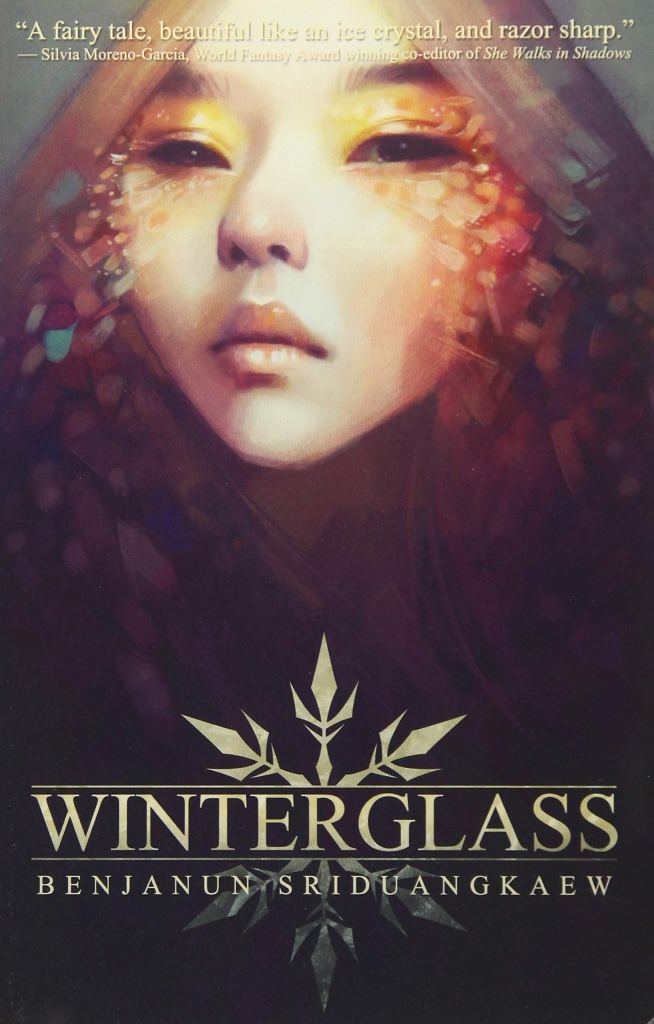
Synopsis:
The city-state Sirapirat once knew only warmth and monsoon. When the Winter Queen conquered it, she remade the land in her image, turning Sirapirat into a country of snow and unending frost. But an empire is not her only goal. In secret, she seeks the fragments of a mirror whose power will grant her deepest desire.
At her right hand is General Lussadh, who bears a mirror shard in her heart, as loyal to winter as she is plagued by her past as a traitor to her country. Tasked with locating other glass-bearers, she finds one in Nuawa, an insurgent who’s forged herself into a weapon that will strike down the queen.
To earn her place in the queen’s army, Nuawa must enter a deadly tournament where the losers’ souls are given in service to winter. To free Sirapirat, she is prepared to make sacrifices: those she loves, herself, and the complicated bond slowly forming between her and Lussadh.
If the splinter of glass in Nuawa’s heart doesn’t destroy her first.
My Rating: ★★★
(A rather unrelated note: have you ever seen a more beautiful cover, dear traveler? Its artist, Anna Dittman, is an absolute legend!)
Maybe I just don’t have enough brain cells to understand this book properly (there are no wrinkles up in my cranium, yo. Up there, it’s as smooth as the rolling sea), but I must say: Winterglass was rather difficult to dig through!
First, the positive:
I loved Winterglass’s poetry. That’s the best way to describe this book — it’s poetry through and through. Sriduangkaew’s style was evocative, and left me staring at its pages in dazed, yearning contemplation.
In lucky moments, I could feel the chill of the Winter Queen, gazing at me with her dark, glacial eyes. Faintly, I could hear the chanting of the spectators as Nuawa, the Lightning, grappled with opponents in the arena. If I squinted, I could see the crystalline colors of the bustling world of Sirapirat in all its glory.
Here are some of my favorite lines, out-of-context:
✧ “She imagined then that the queen was iron and rime underneath too, dense strong bones inside the annihilating white of her skin.”
✧ “There was a time, young and full of ideal, when those words would have stung her tongue and stoppered her throat. No longer; now they are rote. Existence is a performance.”
✧ “Unwise to say, she realizes as she speaks, but her reason is lagging far behind her mouth.”
✧ “Time dilates.”
✧ “If she must kill them all over again, she will. It will be menial, but it is a language in which her fluency is total.”
✧ “The gun is firm in her grip, the metal of it the same as it has always been, agnostic to circumstances and indifferent to emotion.”
And the best line, in my eyes:
✧ “…the wet slap of viscera meeting glass…”
Let me tell you, traveler: I’m a sucker for a wet slap!
I shiver at the thought of these phrases and sentences. They’re so vivid — so wild — so sexy. As my fellow Generation Z-folk say, we love to see it.
Tangentially, I learned so many new words through Winterglass. I deeply stan a novel with a lexicon. (Pleat and wrinkle my brain, amen and please!)
Here are a few terms I picked up, along with their definitions as provided by Google and Wikipedia’s dictionaries:
| Abattoir | A slaughterhouse. |
| Apocryphal | Of doubtful authenticity, although widely circulated as being true. |
| Katabasis | A descent of some type, such as moving downhill, the sinking of the winds or sun, a military retreat, a trip to the underworld, or a trip from the interior of a country down to the coast. |
| Oneirology | The scientific study of dreams. |
| Opprobrious | Expressing scorn or criticism. |
| Phantasmagoria | A sequence of real or imaginary images like those seen in a dream. |
| Rictus | A fixed grimace or grin. |
(Watch me weave these into my works-in-progress and English essays somehow, wink wink wink!)
I have sung my praises. And now, to climb —
The book had its shortcomings:
Truly, Winterglass was poetry. But poetry alone cannot shape a story.
For all the novel’s beautiful writing, none of this prose gave me a good sense of place or character (despite its many breathtaking environmental descriptions).
As a result, I was unable to engross myself into the novel and ground myself in the chaos of the narrative.
Was there even a narrative at all, I wonder? Winterglass was a string of pearls I did not know how to link.
The elevated vocabulary, as fantastic as it was, contributed to my confusion. (It’s because I am, at times, a fool. This I can confirm. Still —) Why use this complicated, little-known word here? I inquired, in different contexts while reading. Why not use something simpler, which may convey meaning more effectively? Sometimes, Winterglass’s archaic — though gorgeous — terminology distracted from the course of a scene.
I struggle to concretely recall the winding plot, or how Nuawa changed throughout that plot. The relationships didn’t feel properly conveyed — perhaps this was on account of the distance I felt towards Nuawa, Lussadh, and the people they encountered. Winterglass‘s intricate composition detached me from the intentions and thoughts of the protagonists.
With Winterglass, I had high expectations. Its preview-prologue and synopsis, both of which I perused on Goodreads, intrigued me. I was excited to read an Asian-inspired fantasy (based on the story of the Snow Queen, no less!), and overjoyed when I heard that the novel featured sapphic protagonists and genderqueer representation.
But I didn’t love its story as much as I wanted to. I hoped to receive a diamond, but was instead disappointed by scattered, blunted shards.
Spectacular language buried, rather than bolstered, Winterglass’s coherency.
It’s worth the read nonetheless. A gem is a gem, no matter how scratched. I’m definitely reading the sequel — and I’ll let you know when I do.
Thank you for reading my first book review on this blog! Stay hydrated, and take care of yourself!
Up next on this blog: a review of the film Parasite (2020)! Don’t miss it!
 Sophie Ligaya dela Cruz